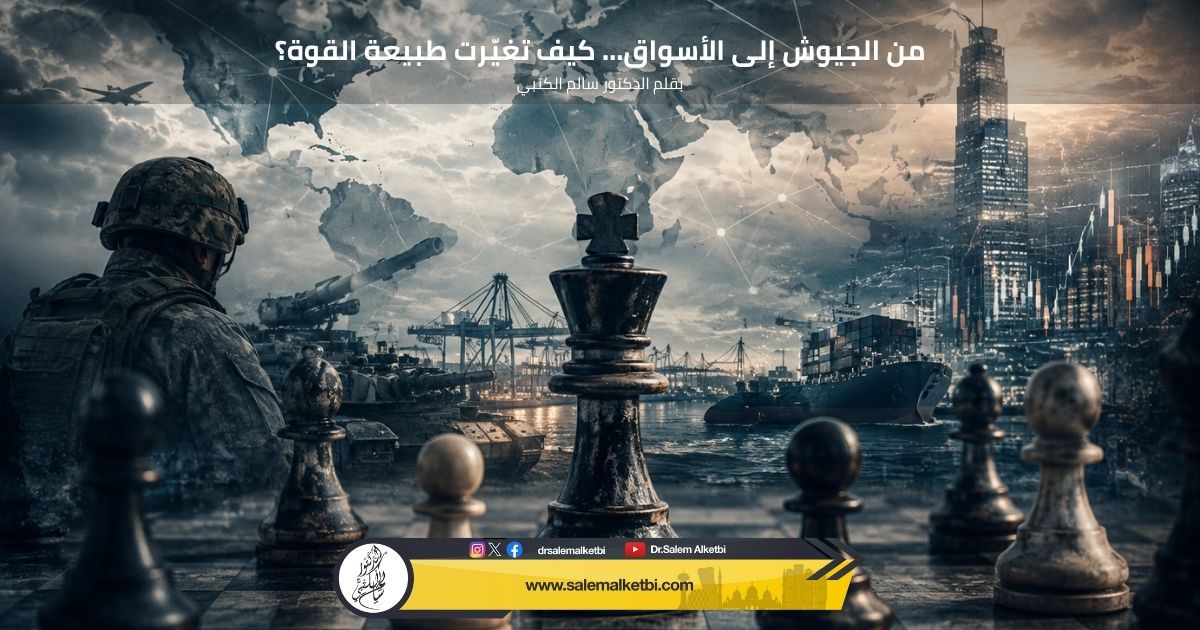
Wars no longer begin with tanks, as the world had grown accustomed to throughout the last century. What is changing today is not merely the form of conflict, but the very definition of power; major nations no longer rely solely on armies to project influence or weaken adversaries. Instead, they employ tools once categorized as strictly economic—such as energy, technology, supply chains, sanctions, ports, currencies, and even food. The adage attributed to Henry Kissinger—”Who controls the food supply controls the people; who controls the energy can control whole continents”—now appears less like an old political musing and more like an accurate description of the new global order. Markets are no longer just arenas for trade; they have gradually transformed into battlegrounds no less perilous than traditional fields of combat.
This shift did not occur overnight, yet it has clearly accelerated in recent years. Western sanctions against Russia following the war in Ukraine were not merely fleeting financial measures but constituted one of the most extensive campaigns of economic pressure in modern history, with the number of sanctions imposed on Moscow exceeding sixteen thousand, according to international estimates. Conversely, Russia treated energy not merely as a commodity, but as a strategic lever—a tool to destabilize Europe and force a recalculation of the continent’s winter, energy, and inflation dynamics. Thus, the conflict was no longer confined to the front lines; it extended to gas pipelines, ports, banks, payment networks, and insurance systems. The same pattern is playing out in the US-China rivalry, albeit with far more complex tools. The battle is no longer solely about military influence in Asia; it now centers on control over microchips, advanced technology, supply chains, and rare earth minerals. Taiwan alone produces over 60 percent of the world’s semiconductors—and more than 90 percent of its advanced chips—explaining why this industry has become a matter of national security for major powers. In this context, restricting the export of sensitive technology to China is no longer merely a commercial decision; it is part of a broader struggle to determine who will hold the keys to the global economy in the coming decades.
Undoubtedly, even crises that appeared on the surface to be health or logistical issues have exposed the magnitude of this shift. The COVID-19 pandemic was not just a medical crisis but a global shock that made nations realize how quickly total reliance on foreign sources for vital industries could turn into a strategic vulnerability. Major powers discovered they could not procure face masks, medicines, or microchips with the necessary speed, as supply chains built on economic efficiency were never designed to withstand political or geopolitical shocks of such magnitude.
Thus began a new phase in redefining national security itself. Security is no longer defined merely by possessing a powerful military or advanced defense systems; it now encompasses the ability to shield the economy from disruption, ensure the continuity of supplies, and safeguard food, energy, technology, and industrial capacity during times of crisis. The President of the European Commission succinctly summarized this shift by stating that “economic security is national security.” This statement is no longer merely a theoretical concept; it has become a guiding principle for major powers as they restructure their industrial and trade policies.
In reality, the economy is no longer merely affected by war; it has become a weapon used to wage war itself. Sanctions, asset freezes, technology cut-offs, payment disruptions, control over maritime corridors, and pressure on supply chains are all tools employed today to achieve objectives once assigned to armies. The distinction lies in the fact that these tools entail lower political costs, are sustainable over longer periods, and can sometimes inflict greater pain than direct military confrontation.
Undoubtedly, this explains why many nations are rethinking concepts that seemed settled for decades; economic efficiency alone no longer suffices if achieved at the expense of strategic resilience. Total reliance on foreign sources is no longer the comfortable option it was during the era of open globalization. Even the very notion of the “free market” is receding in the face of national security imperatives and geopolitical rivalry.
In this context, a nation’s standing is no longer measured solely by the size of its GDP or financial reserves, but by its capacity to withstand prolonged shocks. Who possesses industrial capacity? Who can pivot their economy during a crisis? Who controls critical technologies? Who ensures the uninterrupted flow of energy, food, and medicine? These questions have become integral to the calculus of deterrence, rather than remaining isolated economic issues. Thus, a new phase of the global race has begun—not merely an arms race, but a race to rebuild economies for greater resilience in a world trending toward prolonged and complex conflicts. The United States is discussing the domestic reshoring of vital industries; Europe is seeking to reduce its reliance on external energy sources; China is constructing alternative technology and financial networks; and other nations are attempting to build reserves and domestic production capabilities in anticipation of widespread global disruption.
The problem is that many nations still view the economy through a pre-transformation lens, treating it as a development issue distinct from national security. In reality, however, the economy has become integral to the architecture of deterrence and sovereignty. A state that relies entirely on foreign sources for food, industry, technology, or even payment systems effectively places part of its sovereign decision-making power beyond its own borders, rendering it highly vulnerable at the onset of a major crisis. Ultimately, nations that fail to build their economies as systems of resilience may discover, during a moment of genuine pressure, that their sovereignty was far more fragile than they had imagined.
The world is not heading toward the total demise of globalization, but it is clearly moving toward an era where the rules of interdependence are being rewritten. Trade will continue, and markets will remain open to varying degrees; yet, the absolute confidence that the global economy can remain insulated from political conflict appears to be an idea that is fading.