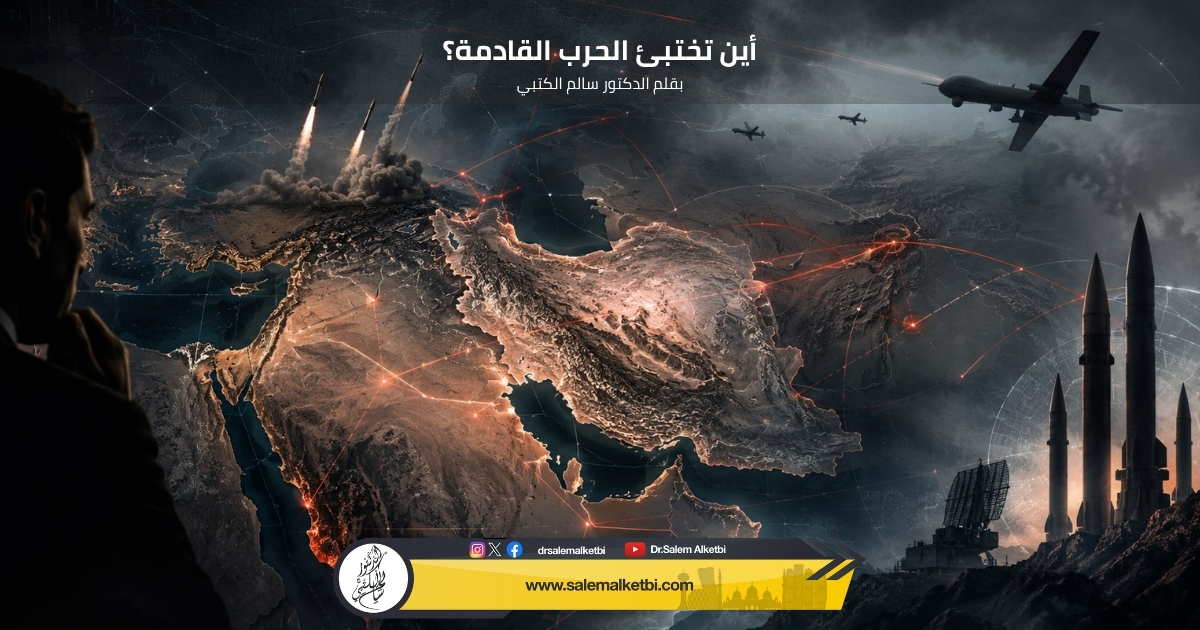
A colleague asked me—in a tone betraying a search for reassurance—for my thoughts on the US-Iran agreement, a deal that might or might not come to fruition. I gave him an unexpected answer: for all the clamor surrounding the headlines, this agreement does not capture my interest. This is not to dismiss its importance; rather, my focus lies beyond the immediate moment—on a weighty question that many avoid: What preparations are we making for the coming war—the day Iran regains its missile capabilities, restores its financial solvency, and resurrects its scenario of regional terrorism? When will that war arrive? What will its nature be? How might it unfold? And why might the region find itself facing it all over again?
Asking about the agreement is not wrong in itself, but such inquiries often stop at the present moment without delving deeper. Agreements are a matter of tactics, whereas structural dynamics are a different issue entirely. A discerning look at Iranian history reveals a recurring pattern: periods of de-escalation have never signified an abandonment of the expansionist agenda; instead, they serve as a temporary respite—a window allowing Tehran to catch its breath, regroup, and replenish its arsenal in preparation for the next round. The regime is inherently aggressive; it views de-escalation solely as an opportunity for circumvention, and nothing deters it except a painful cost that threatens its very survival. Consequently, should the agreement see the light of day, it will not mark the end of the threat, but rather a new chapter in its ongoing saga.
For this reason, I view it as merely a part of the picture, not the whole; The real issue lies not in what will happen the day the agreement is signed, but in the long-term consequences that may follow. Understanding the situation begins with grasping the reasons that will drive Iran to rebuild its military capabilities; this point holds the key to everything else. Iran’s security doctrine was not built upon a conventional air force capable of rivaling its adversaries; instead, it relies on a triad designed to compensate for its weaknesses: strategic depth, a network of proxies, and an arsenal of missiles and drones. These three elements are not merely hardware to be bought and sold; the regime views them as the guarantee of its very survival. Consequently, losing them in war would mean a loss that extends far beyond mere stockpiles to the very core of its security doctrine.
Hence the certainty that rebuilding is inevitable. A regime that views its missiles and proxies as essential to its survival will not voluntarily abandon them, regardless of how long a period of calm lasts or how severe sanctions become. In fact, pressure and exhaustion do not deter the regime from its project; rather, they drive it toward defiance and an even more stubborn pursuit of its goals. Tehran might emerge from this round exhausted, but for this regime, exhaustion fuels a desire for revenge rather than a turn toward moderation. A resurgence is not merely a likely possibility; it is a behavior deeply rooted in the nature of the regime itself.
As for the timing of this renewed threat, that remains the most complex aspect, as it is governed not by a single trajectory but by three, each moving at its own pace. The first is financial: when will Iran regain its solvency and capacity for spending? This hinges on the lifting of sanctions and the release of frozen funds and oil revenues. Here, the agreement that was previously disregarded comes back to the fore; it could either fund rearmament or—conversely—delay it through the inspection restrictions it imposes. Thus, the very issue I chose not to focus on might be what ultimately dictates the timing of the matter that currently concerns me.
The second track is industrial: when will Tehran rebuild its missile and drone production lines? The answer is likely sooner than optimists estimate; technical know-how does not vanish under bombardment, factories can be rebuilt, and expertise remains with those who possess it. Many military experts believe that restoring significant production capacity could take anywhere from a few months to two years—not the full decade some might hope for.
The third track is regional—the slowest and most arduous of the three. Restoring the network of proxies relies not on metals and factories, but on people, loyalties, and a geography exhausted by war. This may well prove to be the longest and most difficult phase of the comeback. The true window of danger opens when these three tracks converge: released funds, restored production, and rehabilitated proxies. A slowdown in any one of them would delay the others; consequently, many observers estimate that this window of risk will open in the mid-to-late part of the decade, provided the three tracks proceed in parallel.
While the timing of the danger is a subject of debate, the nature of the next war is no less critical for anyone wishing to prepare for it seriously; the lessons Iran draws from the current conflict will shape the characteristics of its future weaponry. It is most likely that they will adapt the existing pattern rather than simply repeat it. They may move toward deeper decentralization—distributing production and launch capabilities, and concealing them underground or within urban areas to complicate preemptive targeting. They might also prioritize low-cost quantity over high-cost quality, overwhelming expensive defense systems with swarms of drones costing only a few thousand dollars each. This highlights a critical challenge: the next war will be as much a battle of costs as it is a battle of firepower.
This brings us to the practical question of the necessary level of preparedness. Serious preparation revolves around three core pillars. The first is that the sustainability of defense is just as important as its effectiveness; the current round of conflict has demonstrated that interception is possible but prohibitively expensive. Consequently, future preparedness requires establishing a low-cost interception layer to prevent the defensive shield from being financially exhausted before it is breached by kinetic force.
The second pillar concerns the issue of preemptive strikes. It is clear that one should not wait for Iran to complete its reconstruction; rather, the infrastructure should be struck while it remains vulnerable. This dilemma troubles the relevant capitals: should they choose “mowing the grass”—periodic strikes to prevent the accumulation of capabilities—or wait for the threat to fully mature? The correct course of action for these capitals—Israel foremost among them—is to opt for periodic strikes rather than waiting.
The third pillar concerns the most critical front of all: halting the flow of funds, technology, and spare parts needed to keep factories operational. In this context, the agreement must be treated as a strategic weapon rather than a peripheral issue. The conditions regarding inspections and sanctions will determine the pace of Iran’s resurgence more than any air strike; consequently, they must be made as stringent as possible.
It is also worth noting that this declared state of readiness involves a debate as old as politics itself. Iran monitors this discourse and is aware that its adversaries are gearing up; it, too, is planning for its next war. Indeed, one could argue that the preparations made by others are precisely what drive Iran to arm itself.