Debate regarding Iran’s missile arsenal has resurfaced, driven by the argument that it is unfair to demand Iran relinquish its missile capabilities while other regional states possess similar ones. Yet, this perspective overlooks a more fundamental question: does the problem lie in the mere possession of missiles by nations seeking self-defense, or in a massive offensive arsenal—built over decades—that has evolved into an instrument of regional influence and intimidation?
This is precisely where the paradox lies: the issue is not so much a mutual arms race between equals as it is a strategic imbalance that has imposed itself on the region over decades—an imbalance to which Iran’s neighbors are now expected to adapt, rather than seek ways to rectify or counterbalance.
Iran has not merely developed a vast missile program; it has transformed missiles into a distinct strategic language. It employs them as a tool for deterrence, a means of exerting pressure, and a projection of influence that extends far beyond its own borders. In contrast, the Gulf states have for decades remained in the position of recipients—purchasing defensive systems without possessing the capacity to counterbalance the offensive threat on their own terms.
The deeper issue is that major powers manage this file not based on principles of fairness or balance, but rather on the ability to influence the parties’ behavior. Gulf allies are consistently urged to exercise restraint because their actions can be influenced; Iran, however—having established its missile program as an entrenched strategic reality—is dealt with through containment, negotiation, and risk management, rather than through efforts to prevent the threat from arising in the first place. The Iranian attacks targeting Gulf states during the 2026 war starkly exposed this vulnerability, demonstrating that these nations could become direct targets of missile strikes even when they were neither the initiators of the conflict nor primary belligerents.
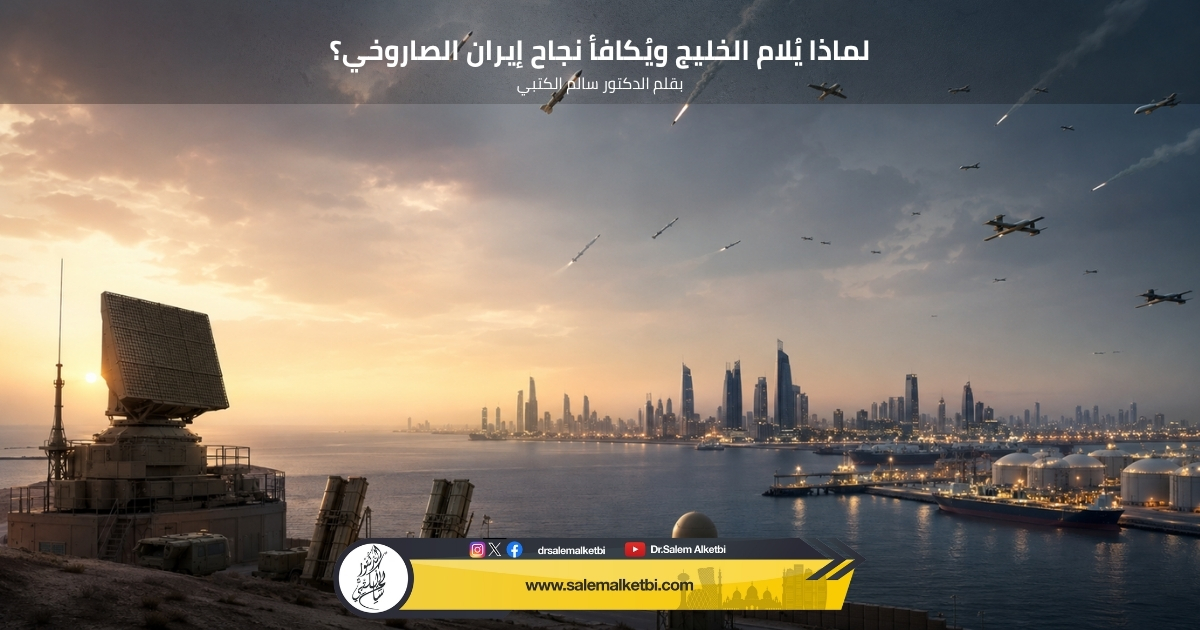
The UAE served as the most prominent example, having been subjected to intense waves of ballistic missiles, cruise missiles, and drones. The significance of these attacks lay not merely in the volume of projectiles involved, but in the lesson they imparted: a stable, open Gulf state integrated into the global economy could find itself at the epicenter of a confrontation as Iran sought to escalate the cost of war for its adversaries.
This highlighted a more profound reality: the attacks were not merely a fleeting military incident. They revealed that economic stability and global openness do not confer automatic immunity against the logic of missile warfare. Furthermore, they demonstrated that a Gulf state—regardless of its developmental success or integration into the international economy—could become a direct target when missiles are employed as a tool to impose political or strategic costs on others. More importantly, the 2026 war did not merely reveal the scale of the threat; it exposed the limitations of the assumptions that had governed regional security thinking for decades. A long-held belief prevailed that international partnerships, economic strength, and integration into the global order were sufficient to reduce the likelihood of direct attack or raise its political cost for the aggressor. However, events demonstrated that an adversary’s possession of extensive offensive capabilities remains a decisive factor that transcends many traditional political calculations. From this perspective, the war was not merely a fleeting military confrontation but a strategic turning point, confirming that sustainable security rests neither on prosperity alone nor on external partnerships alone, but on a deterrent capability that renders the cost of aggression far higher than any anticipated gain.
Yet, the lesson revealed by the war extends beyond military calculations to the very way the threat itself is perceived; herein lies the double standard inherent in the prevailing narrative. When Iran or its proxies strike, the world often focuses on managing escalation, de-escalating tensions, and averting a major conflagration, rather than addressing the fundamental question: Why has an offensive arsenal of this magnitude been allowed to evolve into a quasi-normalized regional fixture? And why is the Gulf consistently expected to act as the most rational and restrained party—even when it is the one most exposed to fire and faces the highest costs in defending itself? Then there is the economic dimension—far from a mere detail, it is a core element of the equation. Beyond the impact of the initial military shock, Iran is banking on a clear strategy of attrition, employing relatively low-cost offensive assets against exorbitantly expensive defenses. This means that every wave of attacks is tested not only in the skies but also in national budgets; Gulf states pay the price not just for the security threat itself, but for the ongoing cost of deterrence—protecting their cities, facilities, ports, and vital energy fields. Consequently, the Gulf is effectively compelled to finance a deeply unbalanced regional status quo, while the aggressor retains the advantage of lower costs and a superior capacity for attrition.
Admittedly, Gulf states bear some responsibility for their delay in establishing a more independent collective deterrence doctrine and for their long-standing reliance on external security guarantors. Yet, this does not alter the fundamental reality: the missile imbalance was not of the Gulf states’ making; rather, it was imposed by Iran through decades of military buildup.
Therefore, any serious discussion regarding regional security must begin with an unambiguous premise: either there must be uniform, genuine constraints on offensive missile capabilities across the region—starting with Iran—or there must be explicit recognition of the Gulf states’ right to build a deterrent capable of redressing this imbalance. The problem no longer lies in the Gulf’s pursuit of enhanced security, but rather in the continued treatment of a chronic strategic imbalance as a fait accompli to which one must adapt. Anything less amounts not to a balanced regional security policy, but merely to the diplomatic management of a chronic strategic imbalance—the security and economic costs of which are borne by the Gulf, while others content themselves with managing the repercussions.